
Commissaire Maigret: Would Simenon’s Famous Detective Recognize Paris Today?

- SUBSCRIBE
- ALREADY SUBSCRIBED?
BECOME A BONJOUR PARIS MEMBER
Gain full access to our collection of over 5,000 articles and bring the City of Light into your life. Just 80 USD per year.
Find out why you should become a member here.
Sign in
Fill in your credentials below.
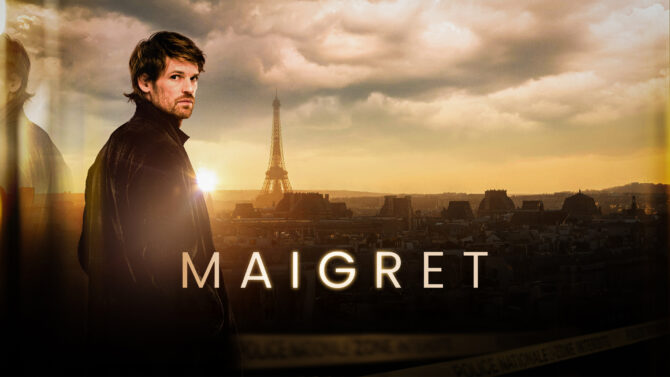
The PBS Masterpiece channel recently premiered a TV adaptation of Georges Simenon’s beloved novels, starring Benjamin Wainwright as the Parisian Chief Inspector…
When I was an adolescent our bookcase at home held several books from a book club my mother had subscribed to when she was younger. One of these books was a pair of Maigret novellas by Georges Simenon. This is where my personal love affair with Paris began. One, Maigret in Montmartre, climaxed with a pursuit through the narrow streets and I was captivated by the street names: Rue Caulaincourt, Rue Lepic, Rue du Mont Cenis. I went on to read most of Simenon’s Maigret novels and Paris became this wonderful place that one day I absolutely had to visit. Fifty years later I am lucky enough to now live here (Simenon also instilled in me an enduring love of mystery fiction).
Georges Simenon was mainly famous for two things: he claimed to have slept with more than 10,000 women, and he wrote his books in around 10-14 days (to be fair, they only average around 150 pages). He began the Maigret series in 1931 and published the last title in 1972, spanning 40 years of Parisian history. Greatly impressed by the “hard-boiled” style of American writers like Dashiell Hammett, he imported a gritty, realistic view of the underside of Paris, while inventing the modern “police procedural” mystery novel.
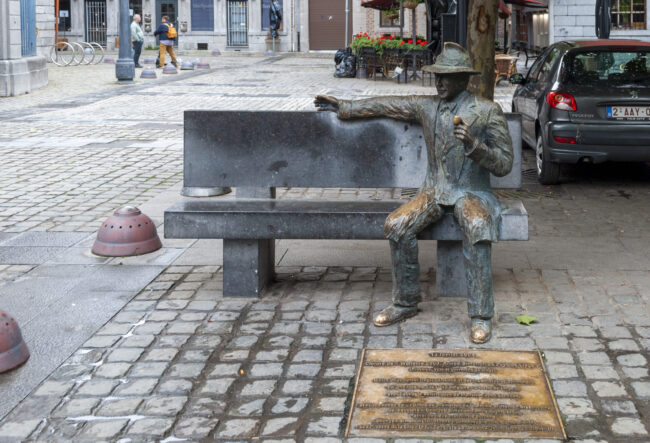
Bench and sculpture dedicated to Simenon in his home city of Liège. Photo: Dominic Nelson/ Wikimedia commons
His Commissaire Jules Maigret is one of 20th-century fiction’s iconic law enforcement officers: thoughtful, pipe-smoking, interested in the people involved in the crime almost more than the crime itself. He displays empathy towards the perpetrators as well as the victims and is rarely judgmental. He has been portrayed numerous times on TV and film and PBS has recently shown a brand new update on its Masterpiece channel. The producers have done what Omar Sy did for Arsène Lupin a couple of years ago and brought the character and series into the 21st century. Maigret is young, his wife is a psychiatric nurse and they are trying for a baby. His team is multiethnic and his officers Lucas and Janvier are women. If you are familiar with the novels you have to leave your preconceptions of Maigret at the door but, like Sy’s interpretation of Lupin, this is a thoroughly enjoyable remake of the classic stories.
Recent remakes of Maigret have been filmed in Budapest since nowadays it’s hard to find authentic 1950s-looking streets in Paris. This version was also partly filmed there because the schedule clashed with the 2024 Olympics. But there are still scenes that are recognizably Paris and this comes back to the visual quality of Simenon’s writing. You can walk through Paris virtually simply by following his detailed mapping of the streets. If you know the city it’s fascinating to see what has changed — and what has not.
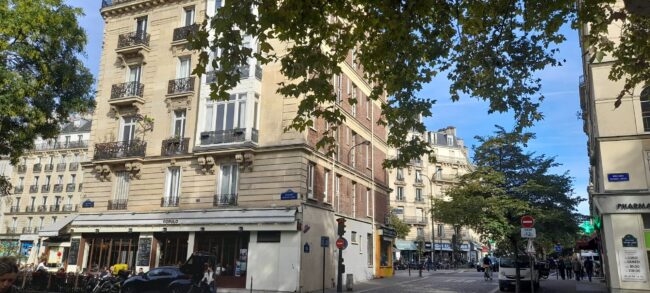
132 Boulevard Richard-Lenoir, Maigret’s fictitious home. Photo: Pat Hallam
It all starts with Maigret’s home at 132 Boulevard Richard-Lenoir in the 11th arrondissement. In some respects the street has changed very little. His building is in a solid Haussmann style, still popular with middle-class families. The gardens that run down the middle of the boulevard were laid out in the 1920s, mainly to hide the ventilation shafts of the Canal Saint Martin, which flows underground at this point. Although the gardens were updated in the 1990s, there would have been some squares and greenery in Maigret’s day. As he stood by his window puffing on his pipe, he might have seen men playing boules a bit further down, exactly as they play pétanque today. The new Maigret still lives in the 11th, but the boucheries and boulangeries in Rue Oberkampf where he buys his groceries are now very bobo, which befits this younger incarnation (in one shot you catch a glimpse of the artisan boulangerie Chambelland).
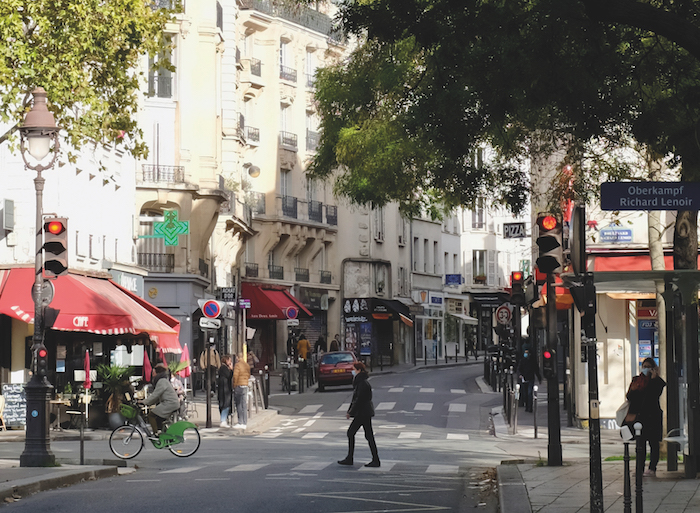
Rue Oberkampf has become a destination for foodies. Photo credit © Jeffrey T Iverson/ France Today
One landmark Maigret would have known well was La Grosse Bouteille on the corner of Rue Moufle and Boulevard Richard-Lenoir: a café sporting a 2m-high bottle perched on the tip of the roof advertising the apéritif Picon. This was regularly photographed, by Robert Doisneau among others, but the café was eventually demolished in 2017 to make way for the Jardin Truillot. Apparently the bottle was saved but no one seems to know where it is now — probably gathering dust in someone’s cellar.
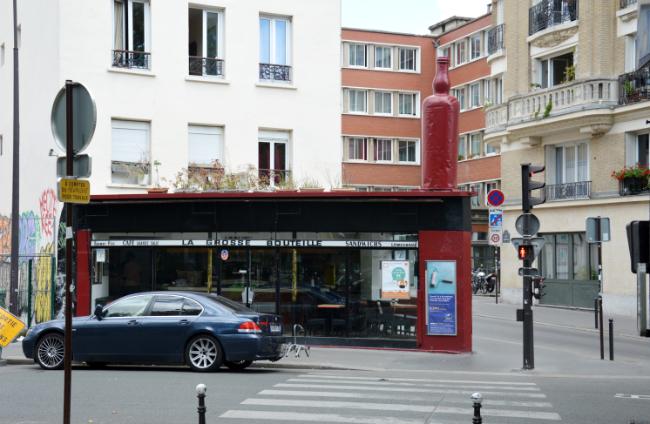
bar La Grosse Bouteille on boulevard Richard Lenoir. Photo: Teknad/ Wikimedia commons
When he left his apartment for work, Maigret sometimes caught the bus and in later novels regrets the end of the open platform buses where he can smoke his pipe. A few of these are still around, used for wedding hire, so if you are lucky you might see one and be able to imagine 1940s and 50s commuters on board. He never seems to use the métro which is a shame as I’m sure Simenon would have brilliantly evoked the wooden-seated carriages, the division of 1st and 2nd class passengers, and the poinçonneurs, or ticket-punchers.
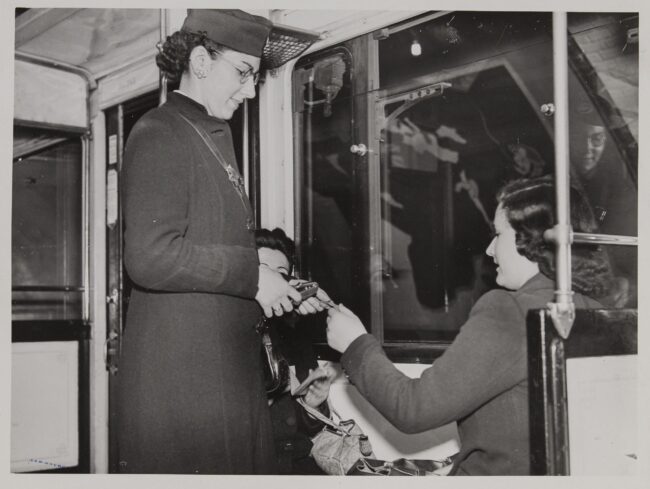
Métro parisien : contrôle des billets en 1ère classe. Photographie Compagnie du métro parisien. Tirage au gélatino-bromure d’argent. 1943. Paris, musée Carnavalet.
Maigret leads a very normal domestic life, having small dinner parties with his friend Dr Pardon and his wife, and often going to the cinema with Mme Maigret – might that have been to the Majestic? The cinema is still independent, on the corner of Boulevard Richard-Lenoir and the Place de la Bastille.
The Place would have been dominated by the Paris-Bastille train station, disgorging thousands of suburban commuters every day. It closed in 1969 — a few years before the last Maigret novel – when the RER A line opened. The station was finally demolished in 1984 to make way for President Mitterrand’s Opéra Bastille, while the railway line itself found a second life as the Coulée Verte. Undoubtedly the large cafès and brasseries which surround the Place de la Bastille would have been there in Maigret’s day, albeit under different names and unrecognizable inside or out. Actually, an aerial photograph taken shortly before the station was demolished clearly shows a large brasserie that until recently was called Les Grandes Marches; it’s now called O’Sullivan’s but the upper façade has not changed a bit.
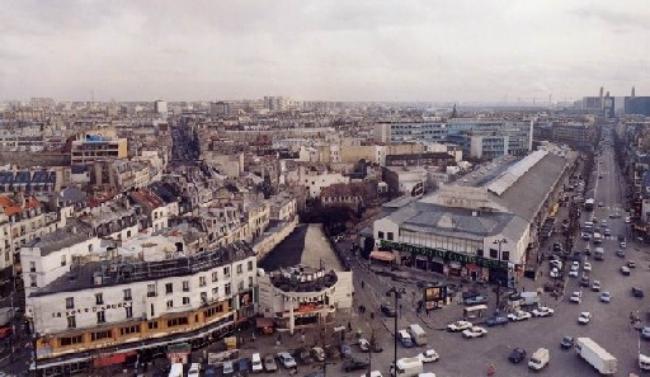
Aerial view of the Gare de la Bastille in the 1980s. Wikimedia commons
Of course, the iconic address in all the novels is 36 Quai des Orfèvres on the Île de la Cité, HQ of the Police Judiciaire or detective branch. Many a long night’s interrogation was punctuated by regular trays of beer and sandwiches from the fictional Brasserie Dauphine. Sadly, none of this exists today: the modest brasseries in the Place Dauphine have been supplanted by smart but very touristy restaurants and the police themselves have moved out to the new Tribunal de Paris just beyond the Porte de Clichy in the 17th. 36 Quai des Orfèvres is currently hidden behind billboards as the Palais de Justice undergoes a major restoration. But the TV series gives a nod to the old tradition — at one point Maigret tells his team to “order in,” although this means consulting takeout menus and presumably delivery by UberEats.

36 quai des Orfèvres in Paris. Photo: Jebulon/ Wikimedia commons
Maigret’s hands-on approach to detective work allows him to wander far and wide across Paris, from the secluded houses of the wealthy in the 16th arrondissement to the slums of Belleville and the sleazy strip clubs of Pigalle (which was still a proper red light area). Quartiers which are now gentrified are portrayed as the shabby, rundown neighborhoods many of them were. The ninth arrondissement, for example, around the Rue de Douai, or the second around Rue d’Aboukir, are filled with small businesses such as dress hire shops, seamstresses and pawnbrokers catering to residents with little money. You still get a flavor of this, especially around the Rue d’Aboukir and its clothes wholesalers, or the semi-abandoned Passage du Caire, both of which have a permanent down-at-heel feeling. Or in the streets around the Portes Saint Denis and Saint Martin: filled with dodgy-looking import-export businesses and more clothing and footwear wholesalers.
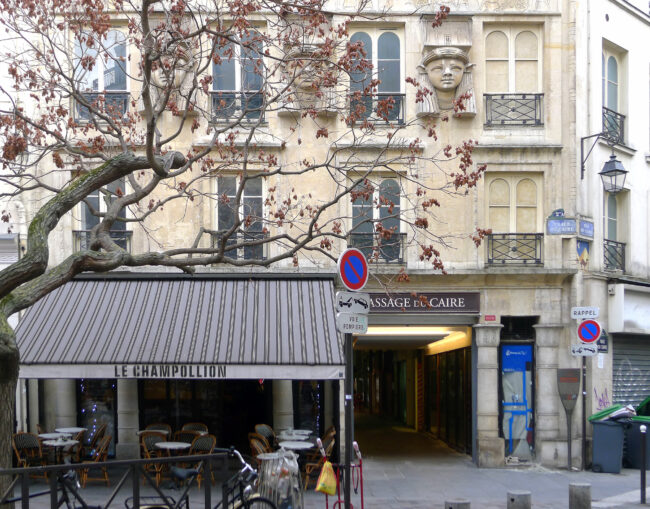
Entrance to the Passage du Caire. Photo: Mbzt / Wikimedia commons
Simenon’s local inhabitants live in unmodernized apartments with dim electric lights, old-fashioned gas rings, and toilets on the landing (most probably still squat toilets). Apartment buildings where the ubiquitous blue and white plaque “Gaz à tous les étages” (gas on all floors) had only quite recently stopped meaning something aspirational. And there is always the concierge, the apartment building’s busybody, noticing everyone’s coming-and-going from her lodge. Poorly paid, tied to a cramped, dark apartment, it’s little wonder concierges are not often portrayed in a positive way. Apart from gardien(ne)s in upmarket or more modern résidences, the concierge, once a Parisian institution, has been replaced by digicodes and electronic entry fobs.
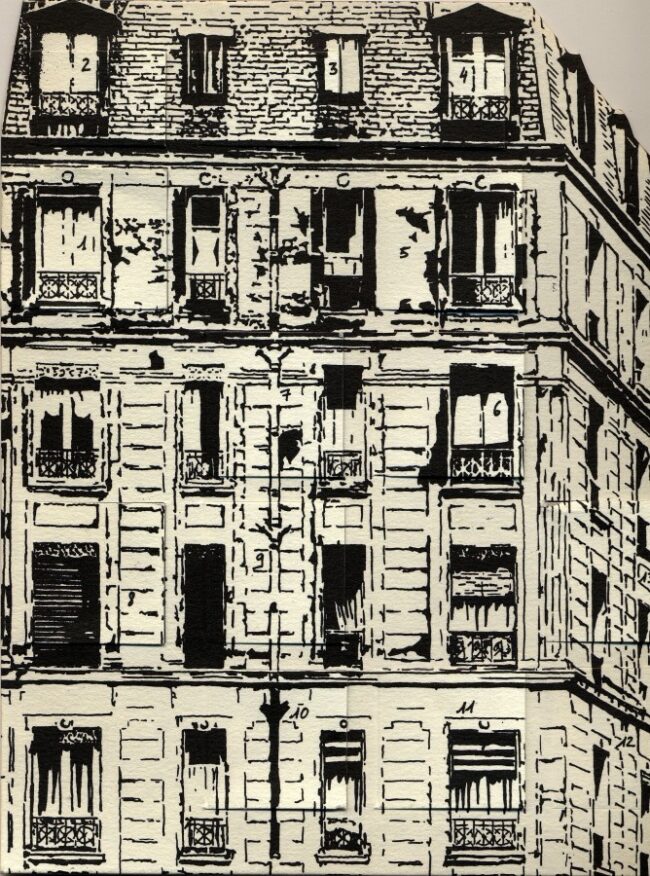
“Eau et gaz à tous les étages” exhibit at the Pavillon de l’Arsenal.
Street names change less frequently than buildings but even they are not totally immune. The most obvious example is the Place de l’Étoile. No mention of Place Charles de Gaulle in Maigret’s time. The World War II hero was in the political wilderness in the late 1940s and 50s and even in the 1960s presidential years he had not assumed the veneration he would enjoy after his death. Numerous other streets have changed names over the decades as once-public figures now forgotten are replaced by newer versions, or sometimes victims of an atrocity, or the recognition of a colonial event. Occasionally they are even replaced by a woman! The Square Dominique Bernard is a case in point. Situated almost opposite Maigret’s apartment, it was renamed in 2024 to commemorate the assassination the previous year of a teacher while he was protecting his pupils during a terrorist attack.
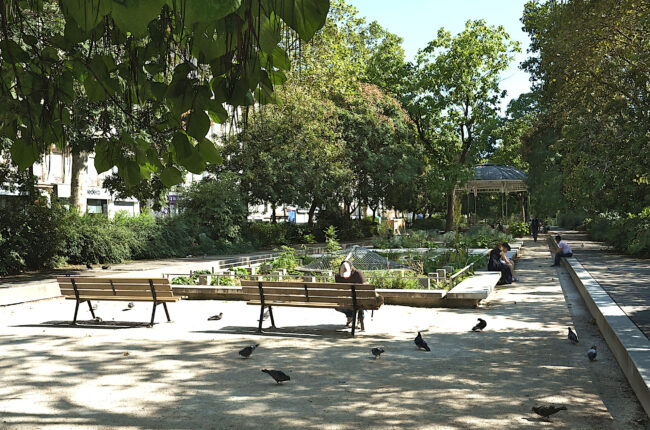
Le square Dominique-Bernard. Photo: Mbzt / Wikimedia commons
Maigret spends hours in cafés while working an investigation. These are always family-run businesses, offering plain provincial French cuisine and traditional drinks. The loss of cafés is a growing concern in France: down from 200,000 in the 1960s to around 30,000 today. Rising costs, aging patrons, and the long–term effects of Covid (difficulty in repaying loans, the expansion of homeworking, etc) are all threatening the traditional café.
But one change that is arguably for the better is that French people today seem to drink less alcohol. The thing that jumps out of the novels is how much everyone drinks! Working men think nothing of dropping in to their café du coin and downing a glass of white wine on their way to work and the same on their way home (white because it was lower in alcohol than red?). Maigret keeps a bottle of brandy in his office cupboard and any café or bar he enters, he will have a beer or spirit such as calvados. In Maigret in Montmartre, young Lapointe is tailing someone and has to ring Maigret regularly with updates. In an era long before cellphones he can only do that from bars, where he is obliged to buy a drink each time. The police must have been permanently half-sozzled! It never seems to occur to them that a café express would satisfy café etiquette just as well.
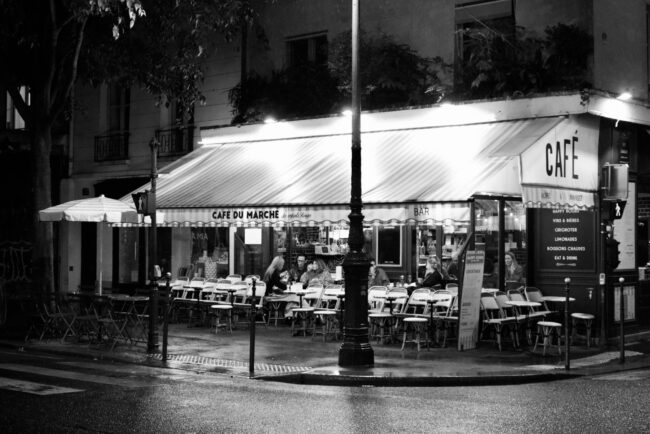
Café du Marché. Photo: Bill O’Such
As with the best of mystery fiction, the Maigret novels are a slice of social history. They portray people leading real, mostly unremarkable lives, detailing their homes, what they ate and drank, how they worked and played. Over a long series such as Maigret we see how their lives change as new technology and changes in social mores affect each generation. But at the heart of Simenon’s books is an obsession with Paris in all its glamour and tawdriness. Even as the city has changed over the years its essential character can still be found if you look for it.

Benjamin Wainwright stars as Jules Maigret in the Masterpiece series.
Lead photo credit : Benjamin Wainwright stars as Jules Maigret in the Masterpiece series.
More in Boulevard Richard-Lenoir, Georges Simenon, Maigret
Related Articles


By Pat Hallam
REPLY
REPLY