Paris Reflections: Notre-Dame-de-Lorette
- SUBSCRIBE
- ALREADY SUBSCRIBED?
BECOME A BONJOUR PARIS MEMBER
Gain full access to our collection of over 5,000 articles and bring the City of Light into your life. Just 80 USD per year.
Find out why you should become a member here.
Sign in
Fill in your credentials below.
The area called Pigalle was teeming with African
American life in the era between the two World Wars. Many of the
‘’after hours’’ clubs established by African Americans became a refuge
for the black American ”expat” community. Although the
Notre-Dame-de-Lorette / Opéra walk features many nightclubs, including
those owned by the first African-American combat pilot, Eugene Bullard
(Bullard was instrumental in the success of ‘’Black Montmartre’’),
there other locations of interest on this fascinating walk.
The
9th arrondissement is also home to the magnificent and historic Grand
Hôtel where in 1919 W.E.B. Du Bois (1868 – 1963), the first African
American to earn a Ph.D. from Harvard University, launched the
Pan-African Congresses in Paris. In a fight against discrimination and
economic exploitation of United Africans and people of African descent,
formed the Congress to focus world opinion on the condition and status
of blacks. Here is an excerpt from Paris Reflections: Walks
Through African American Paris.
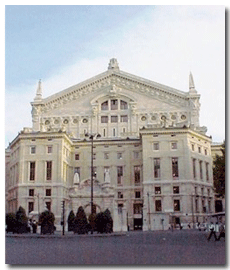 Notre-Dame-de-Lorette / Opéra walk:
Cross boulevard Haussmann, noting the grandiose building across the
square Diaghilev. This is the rear of the Palais Garnier, the
opera house that inspired Phantom of the Opera. You will learn
more about this building later in the tour. Enter rue
Scribe and proceed to the next corner, where you will find the
American Express office at No. 11. For decades, this office
has represented a link to home, whether as a place to pick up mail, to
meet visitors just arriving in Paris, or to rendez-vous with
friends. Jessie Fauset used this office as a backdrop for
her novel Comedy: American Style.
Cross rue
Auber and note the gigantic hotel that sits on the opposite
corner. This is the Grand Hôtel, where W. E. B. Du
Bois succeeded in uniting Africans and people of African descent
for the first Pan-African Congress in 1919. Louis
Armstrong and Josephine Baker are among many African
Americans who have been guests in the hotel.
Continuing
down the street, you will see the Hôtel Scribe at No. 1 on the
right. Josephine Baker stayed at this hotel when she was
performing at the Olympia in 1968.
Turn right
onto boulevard des Capucines and proceed to the first
intersection. Note that on the building at the corner of
boulevard des Capucines and rue Edouard VII, a plaque and an
inscription commemorate the first moving pictures that were shown here
by the Lumière brothers at what was once the Grand Café. Turn
right onto rue Edouard VII and walk to the stately place Edouard Vll,
the site of the Théâtre Edouard VII-Sacha Guitry. Sidney
Bechet performed here nightly in 1949, in a triumphant return to
Paris after his imprisonment and deportation in 1929.
Retrace
your steps to boulevard des Capucines and turn right. A
short distance away is No. 28, the Olympia Music Hall. The
Olympia was founded in 1888 by Joseph Oller, who was also the founder
of the Moulin Rouge. Circuses, ballets, operettas and concerts
were held here before the hall succumbed to the competition of the
cinema and was transformed into a movie theater. In 1954, it was
restored to its original function. All of France’s most beloved
performers have played here, making this a very prestigious hall.
Scores of African Americans have performed here as well, among them
William Marion Cook, Louis Armstrong, Josephine Baker (as
previously mentioned), Sidney Bechet, Mahalia Jackson, Quincy
Jones and Nina Simone.
Retrace
your steps up boulevard des Capucines. No. 12 is still the
address of the Old England department store, where in 1957 Chester
Himes proudly bought “a tan and black checked woolen shirt to go
with my brown and black sports jacket and charcoal brown slacks” and
“an outrageously expensive pair of English-made yellow brogues” after
being paid an advance for the detective novel that he was writing for
La Série Noire.
Continue up the street to place
de l’Opéra. On the corner at No. 3-5 is the Café de la Paix,
where many an African American has watched the flow of pedestrians
along the boulevard and marveled at the experience of being in
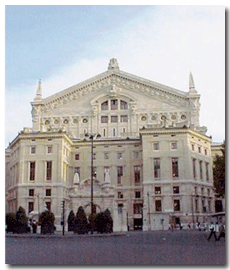
Paris. The square is dominated by the Second Empire opera house,
the rear of which you saw across the street from Galeries
Lafayette. It is called the Palais Garnier, and is named after
its architect, Charles Garnier. Though the ostensible purpose of
the building was to present opera, the design of the foyer received
most of Garnier’s attention. His intent was to create a receiving
area and staircase that would allow the wealthy to flaunt their
clothing and jewelry to the greatest extent possible. It is no
wonder that W. E. B. Du Bois was greatly impressed by the grand
staircase when he visited in 1899.
Many prominent
African Americans have attended performances here. William Wells
Brown was pleased to spot Alexandre Dumas in the crowd when
he attended a performance here in 1849. Gwendolyn Bennett and
Countee Cullen enjoyed multiple performances here in the mid- to
late 1920s. Among the African Americans who have performed here
are Leontyne Price, Barbara Hendricks, and Jessye Norman.
—
Related Articles