Maison Maison Carrée in Nîmes
- SUBSCRIBE
- ALREADY SUBSCRIBED?
BECOME A BONJOUR PARIS MEMBER
Gain full access to our collection of over 5,000 articles and bring the City of Light into your life. Just 80 USD per year.
Find out why you should become a member here.
Sign in
Fill in your credentials below.
I’d
been scouring brocantes and antiquités all over Provence for an old
framed picture of the Maison Carrée in Nîmes for the wall in my office
back in Virginia. I had no clue that my discovery would propel me on a
quest—almost to Spain—to retrace the journey taken by the photograph I
found.
With Virginia ancestors on both my parents’ sides, and having proudly
lived here for more than a couple of decades, it made sense to me to
cover the wall in my office with antique framed portraits of famous
Virginians. These had been collected over a period of several years of
hunting through stacks of dusty portraits in antique shops all over the
eastern US.
Of great interest to me was the path that architect and French
Ambassador, Thomas Jefferson took from Paris to Italy and back between
February and June of 1787. I’d read that he stopped in Nîmes on his way
through the Languedoc region of Southern France and was so impressed by
the Roman copy of a Greek temple (now named the Maison Carrée) still
standing in the center of the modern commercial district that he took
time to measure and sketch it. Later, when commissioned by the
Commonwealth of Virginia to design a capitol building for Richmond, he
pulled out this sketch and used it for the basis of his design. It
wasn’t too long a stretch for me to want to include an antique picture
of this building among my other “famous Virginians.”
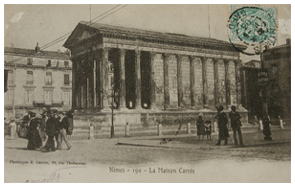
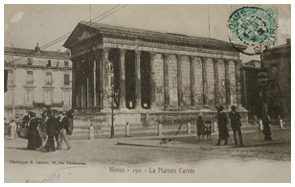
In 1998, a canal-side vendor of old postcards in Provence’s famous
antiques town, Isle-sur-le-Sorgue, helped me find just the thing. The
sepia photo on the front of the postcard was a side view of the Maison
Carrée (Square House in English), and would look quite handsome beside
my prized Washington, Wilson, and Lee finds. Then I made the mistake of
turning the postcard over and I was instantly and hopelessly intrigued
by the mystery of the French scribbling and postmark with date on the
flip side. The provenance of antique postcards is much more apparent
than that of any other kind of antique. And now having just fulfilled
my dream of finding an antique picture of the Maison Carrée, I had to
find out what I could about who had sent it where and to whom and when
and why.
I couldn’t read the French handwriting but I was delighted to find out
from a Provencal waiter that it was sent from Nîmes, of course, in the
Gard département of the Languedoc region on November 6th, 1903 and
arrived at the home of a Monsieur Argence at Number 9, Place St. Joseph
in Perpignan on December 5th. A place (in France pronounced plahz)
sounds so much more appealing than our English “place”. My postcard had
traveled down the path of the old Roman road, the Via Domitia, from
Nîmes to a pretty little place in Perpignan in the département of the
eastern Pyrenees almost a century earlier. Would it be too much to hope
that in 5 years an overly nostalgic romantic Virginian could go to
Nîmes and retrace this postcard’s path to the place in Perpignan after
100 years?
After a week of concerts at the International Piano Festival in La
Roque d’Anthéron, last summer, in the 100th year after the postcard was
sent to Perpignan, my wife and I started at Nîmes and made the same
trip. Driving into the city, we expected to immediately see signs
pointing to the Maison Carrée but saw none. Assuming it was in the
center of the old town we followed the directions to Centre Ville until
we saw the first Maison Carrée signs.
When its right side came surprisingly into view, I almost hit an
elderly lady who pointed up at the light that I wasn’t looking at. Like
other citizens of Nimes, she’d seen it before and perhaps it had become
an irrelevant waste of downtown space—a nuisance to her. For whatever
reason, she wasn’t about to cut me any slack because I just got my
first glimpse of the Maison Carrée.
We parked the car a few blocks away, making Nîmes a safer place for
all, walked back to the Maison Carrée and then up the stairs and like
new parents counted 6 columns across and 11 down each side. It looked a
little crummier up-close than the photos we’d seen. With ragged edges
and chunks of 1,953 year-old marble having slid down the columns and
off the triangle pediment. Inside, displays explained that it survives
today because it’s been in use for one purpose or another—a tomb, a
church, a legislative seat, and a stable, among other things since the
1100s.
The holes across the bottom of the pediment were deciphered to have
once held letters dedicating the temple to a son and stepson of Caesar
Augustus (yes, the one who issued a census decree to the Roman world at
the beginning of the first millennium). If Caesars performed well in
life, they were deified after their death. The temple was built as part
of the imperial cult of Caesar worship that held the empire together
before Christianity. The townspeople of Nîmes wanted to show they were
on board—politically correct—so they helped build this temple to
impress Rome that they were loyal to the imperial cult.
We read all the displays showing how the Maison fit into the huge Roman
metropolitan forum complex that has since disappeared, but the Maison
was a little jewel that no one during the first millennium had the
heart to tear down. We walked around the perimeter and wondered how
anyone could think that building the ugly modern museum across a short
plaza in 1993 was a good idea. We, like Jefferson were awed to be
inside a piece of antiquity built in 50 AD. Unlike Jefferson, we did
not gaze at it for hours, “like a lover at his mistress.” We did
purchase a modern postcard depicting the same scene as the one
addressed to Monsieur Argence at 9 Place Saint Joseph and then headed
out of town toward Perpignan on the autoroute.
South of Montpelier, we were frequently put on notice that we were in
Cathar Country. Far enough from both Rome and Paris to care little for
the authority of either, the 11th century Langedociens were fertile
ground for the Cathar heresy to take firm root. They were exterminated
in the 12th century when Languedoc was acquired and annexed to France.
Also we noted between Beziers and Vias that we crossed the Canal du
Midi, an engineering feat completed in the late 1600s connecting
France’s Mediterranean coast with her Atlantic coast for commerce. The
canal is now used by laidback floating vacationers who want to watch
the vineyards and sleepy little villages go by at a very slow pace.
Nearing Perpignan, I was entertaining a fantasy of a shady Place Saint
Joseph, where, when we arrived, we’d sit on a cool bench by a well
dressed lady, who when asked if she knew of a Monsieur Argence
answered, “Which one? My father? My grandfather? Or my great
grandfather?” And who, at seeing my astonishment said, over the sound
of the nearby fountain, “Oh yes, my family has lived on this square for
many generations.” And then, “You have a postcard that was sent to my
great grandfather in 1903? One hundred years ago? Can you show it to
me? I’d love to have it as a memento of him and to leave to my children
after I’m gone.”
Perhaps, but first we strolled down Perpignan’s Promenade des Plantes,
a long walking park lined with palm trees and plane trees, tastefully
adorned with statues and fountains to get to the Tourist Information
(TI) office at the far end. After a lot of head scratching, map
scrutinizing and squinting, the TI attendant determined Place St.
Joseph must be under the logo of the mapmaker on our map so he couldn’t
show us exactly where it is. He suggested we walk in the general
direction and see if we could find it. But then, “Wait,” he said, “I’ll
check another map.” There was the place plain as day and only a few
blocks from the TI. With a quick merci, we darted out, eager to
discover any traces of the house on Place St. Joseph or the Argence
family. We ascended through a portal in the old ramparts, turned left
on Rue Francois Rabelais, walked past an ancient convent, then, at the
corner, turned right on Rue Saint Joseph. We could see the road widen
ahead. This must be the place.
Without even a glance at each other, a fog of disappointment rolls in
over both of us. This place is the place but it’s a dump—no trees, no
grass, no fountain, no bench, not even a sidewalk. But the place still
exists and there among the beat-up cars and desperate looking
foreigners with dirty babies walking from one dingy apartment to
another was Number 9. It had not been a home for many decades. In an
eyesore of a neighbor hood, it’s the neighborhood eyesore. The barely
discernable sign on the plaster front advertised auto towing and engine
removing and rebuilding. The broken glass on the front door was covered
with a combination of screen and plywood and plants were growing out of
the holes and cracks in the plaster.
Ever hoping for a little fantasy fulfillment, in one of the screen
doors, I spied a little letter flap covering a slit for the mail. Maybe
when Monsieur Argence lived here, my postcard slipped through this mail
slot. Probably not ‑ the entire building must have been remodeled to
convert it from housing for Monsieur Argence to engine rebuilding for
somebody else.
Now, the quest is over, mission accomplished, and all I’ve got to show
for it is the joy of the journey. As we do so often in France when we
experience some endearing combination of beauty and history with signs
of day to day life, Anne and I look at each other and repeat
simultaneously, “This isn’t Disney World, people really live here.”
This time the point is that wishes do come true—some of the time.
Dreams are fulfilled sometimes and sometimes they’re dashed and joy
must be squeezed out of real living even when the prince doesn’t come
through with a kiss in the end. I still cherish my postcard and fondly
re-live the retracing of its journey. And the intrigue of the Canal du
Midi, the Land of the Cathars, and the Roman leftovers in the Languedoc
will pull me back again and again.
Kirk Woodyard and his wife, Anne, host small groups of European classical music festival-goers. Information :www.musicetc.us
Related Articles