David Burke -Self-Interview About Writers in Paris, Literary Lives in The City of Light
- SUBSCRIBE
- ALREADY SUBSCRIBED?
BECOME A BONJOUR PARIS MEMBER
Gain full access to our collection of over 5,000 articles and bring the City of Light into your life. Just 80 USD per year.
Find out why you should become a member here.
Sign in
Fill in your credentials below.
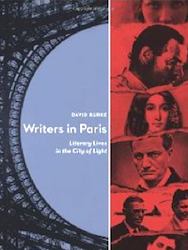 The title of the book says it, really: Writers in Paris …writers and Paris—two of my grand passions combined. I’ve always loved reading, since I was a little kid, and my fascination with Paris—what I read about it, what I heard about it—began long before I ever went there. For young men of my generation, the influence Hemingway and Fitzgerald was enormou; and their expatriate life in France in the 1920s was especially exciting to me. Expatriates! In the America of the 1950s, a very repressive time in our history, that was a magical word. We all read The Sun Also Rises. In fact, on my first trip to Europe, in 1957, when I was in college, my whole travel schedule was based on being in Pamplona from July 7th to 14th for the bullfighting festival, because that was where the climax of the The Sun Also Rises takes place. And most of the story is set in Paris, the second most essential destination on my trip.
But it wasn’t just because of the Americans who’d been there twenty years earlier. We were fascinated Sartre and Camus, who were there. Existentialism! We all read The Stranger and The Plague. I’d seen No Exit in New York and actually went looking for Sartre in Saint Germain-des-Prés. Didn’t find him, of course. But it was very exciting, the Saint Germain-des-Prés of that time. On top of that, my main literary hero was also living in Paris: Samuel Beckett. I’d seen the first production of Waiting for Godot in New York a year earlier. So I went to see the first production on Fin de partie (Endgame) in Paris.
The lives of the writers, both French and foreign, what they wrote, and the places associated with them and their fictional characters, that’s what the book is about.
Q: How did you decide to organize the book?
I decided a geographical approach would work best, dividing the city into its three naturals parts: the Left Bank, the Islands, and the Right Bank. I include only the areas with a literary history, where writers lived or congregated or used as settings in their novels or for poetry.
The first part,“The Literary Left Bank,” covers the Latin Quarter, Saint Germain-des-Prés, the Faubourg Saint-Germain, and Montparnasse. These four districts are broken down into their neighborhoods, Odéon, for example, or Saint-Sulpice within Saint Germain-des-Prés.
“The Seine and the Islands” is the second part: the river and bridges, the Ile de la Cité, and the Ile Saint-Louis, an amazingly literary little island.
The third part, “The Literary Right Bank,” contains: the Marais and the Bastille, The Heart of the Right Bank, Montmartre, and The Beaux Quartiers, the areas developed by Baron Haussmann and his successors in the west of Paris in the late 19th century. Proust lived virtually his whole life in the Beaux Quartiers.
Beyond the three big parts of the city there’s a relatively short fourth part of the book called “A Few Places around Paris.” These are country houses important in their lives and work of writers which are now interesting museums. These include Jean-Jacques Rousseau’s little house in Montmorency, Alexandre Dumas’s extravagant Chateau de Monte-Cristo, Emile Zola’s bizarre house in Médan west of Paris, and the Proust museum in Illiers-Combray, the setting for the opening pages of Swann’s Way.
Q: How did you decide where the book would start?
It starts on what I consider the oldest literary part of Paris as the place where it should start: the Latin Quarter where the University of Paris was founded early in the 13th century. We go back to the times of François Villon and François Rabelais, both students at the university, and the wild adventures of Pantagruel and Panurge. Specifically, I start at the little church of Saint Julien-le-Pauvre, which the university used as its first assembly hall, since they had no buildings of their own at the beginning.
But it’s not just these writers from four and five centuries ago that we deal with in this area. It’s sort of like an archeological dig, with Villon and Rabelais on the oldest stratas, then moving up the layers toward the present we find Restif de la Bretonne in the 18th century, George Sand and Verlaine in the 19th, and in the 20th Jean Genet and Simone de Beauvor. This was at the time Beauvoir was having her affair with Nelson Algren and writing The Mandarins. All these writers were in the lower Latin Quarter, down by the river, across from the Notre-Dame, which is where the University of Paris came into being in 1215. Their ghosts still roam the neighborhood.
Q: Within a given neighborhood, do you always go historically, moving from past to present?
Wherever it works, I start with the past and move toward the present. It makes it easier for the readers to make sense of the stories of the writers than by going from one place to the next strictly the basis of proximity to whatever the previous place was. A good example on my website is the Place de la Contrescarpe, Rue Mouffetard neighborhood, on the fringe of the Latin Quarter. All the places we deal with are within easy walking distance to one another. So in this area I have Villon and Rabelais drinking at the cabarets in the area in the 15th and 16th centuries. Two centuries later Balzac and his characters in Le Père Goriot, Hugo’s Jean Valjean in a very dramatic scene in Les Misérables; the death of Verlaine in 1896 in a building where Hemingway would later rent a room; James Joyce finishing Ulysses in 1921; and Hemingway’s first Paris home just up the street, along with a passage by him about the Place de la Contrescarpe. George Orwell starting his first book, Down and out in Paris in London, a few steps away.
Q: How many writers do you have in the book?
There are 70-80 writers covered in detail with others mentioned. It sounds like an awful lot for a book of only 250 pages, and with 125 pictures and several maps to boot. Each entry is loaded with information yet they’re brief, with parts of the writers’ stories playing out in different localities.
Q: How did you choose what writers to include?
Many “choices” were not really choices. They were inevitable. You can’t NOT have in a book about writers in Paris without having: Moliere, Voltaire, Rousseau, the Marquis de Sade, Balzac, Hugo, Dumas, Flaubert, Zola, Baudelaire, Verlaine, Rimbaud, Proust, Gide, Colette, Joyce, Stein, Hemingway, Fitzgerald, Henry Miller, Georges Simenon, Malraux, Sartre and Beauvoir, Camus, Genet, Richard Wright, James Baldwin and William Burroughs.
Also, since Writers in Paris is written for English-language readers, I limited writers to those with at least some of their works available English. One of my hopes for the book is that it will encourage people to read some of the writers in it. So I don’t want to frustrate them if they try to find books and can’t. All the French works I deal with are available in translation.
Another important limiting factor was that, with one exception, I stopped at the end of the 20th century, essentially with the generation of Sartre and Beauvoir, Camus, Beckett, Richard Wright, Alan Ginsberg and William Burroughs, and Marguerite Duras. Except for Camus and Wright, who died prematurely, they all died in the 1989s and 1990s. One living writer, Patrick Modiano, is the exception.
There are also a few writers who were not residents of Paris, except for brief periods, such as Lawrence Sterne, Charles Dickens, and Henry James. And, of course, there’s Oscar Wilde, a frequent visitor, who died in Paris and is buried in Père Lachaise Cemetery.
Edgar Allan Poe never set foot in Paris, but he’s in the book anyway, because he set “The Murders in the Rue Morgue,” the first detective story ever written, in the city.
Q: What do you hope Writers in Paris will do for your readers?
As I said earlier, one of my big hopes is that what I have to say about the writers will move people to read some of their works. All of these writers are terrific. You can’t go wrong. Or perhaps my readers will be inspired to read the full biographies of some of the writers. There are excellent biographies of practically all of them.
My other great hope is that the stories of the writers’ lives and what they wrote about the city will help my readers will see Paris in a new light as they move about the city, on foot or in their mind’s eye.
Subscribe now for your own free subscription to BonjourParis & we’ll send you Wednesday & Sunday newsletters that link to original France travel stories, news, recipes and travel photography. 50 original stories monthly from your most complete online France travel & Francophile lifestyle eZine. RSS feed available.
If you can get it from Amazon.com, you can get it at our Amazon.com Boutique. Same competitive pricing and speedy delivery as your purchases support costs of keeping BonjourParis your most complete online France travel resource. Merci in advance for your support—we appreciate every centime. Search hint:: start at the back pages for the most recent stock.
Short-cut? Check out Current Favorites for the daily top sellers.
Related Articles