An Interview with Thirza Vallois
- SUBSCRIBE
- ALREADY SUBSCRIBED?
BECOME A BONJOUR PARIS MEMBER
Gain full access to our collection of over 5,000 articles and bring the City of Light into your life. Just 80 USD per year.
Find out why you should become a member here.
Sign in
Fill in your credentials below.
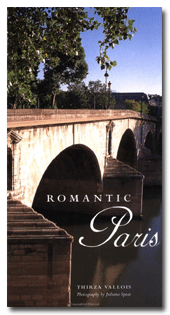 Romantic
Paris is one of the most beautiful, information-packed books we’ve ever
seen about Paris. You know so much about Paris from so many angles.
What made you decide to concentrate on the romantic aspect?
As
explained in the introduction to the book, it actually wasn’t my idea
but my son’s and his then girlfriend’s, now his wife. They thought I
should not only enlighten people to Paris, intellectually, which is
what I did in Around and About Paris, but also offer them the sheer
dream-come-true fun of the city. Since I know Paris from every angle,
it was very easy for me to focus on one aspect rather than another. The
book was actually meant to be titled Paris for Lovers, but many
Americans felt fidgety about such a ‘daring/naughty’ word as ‘lover’,
apparently, so the publisher chose to use the more ‘benign’ adjective,
‘romantic’. In French, the word ‘amoureux’ conveys accurately the
meaning of the word. I guess the closest equivalent in English would be
‘sweethearts’.
clarify matters, a French lady who works in one of the English-speaking
bookshops in Paris thought my book was about 19th-century Paris,
because ‘romantique’ in French usually relates to the literary/artistic
movement. Hence, le Musée de la Vie Romantique in the 9th arr., which
is dedicated to a couple of members of that movement, and not to love,
although they also happened to be famous lovers (eg George Sand). In
other words, if you are into the French language beware of faux amis.
for your comment about Romantic Paris being ‘information-packed’, true,
but only in terms of dream-come-true Paris. The real, meaty stuff is to
be found in Around and About Paris, which is literally all-embracing.
People often think, mistakenly, that it’s only a historical walking
guide. No. It is also a historical walking guide, but it’s much more
than that: it also deals with Le Pen, for instance, with present-day
homelessness, with ethnic issues, with scandals evolving around
building projects in modern Paris. I have literally researched all the
different aspects of Paris, past and present, and brought them together
to the readers, to help them explore beyond the blinkered surface of
the tourist track, so as to gain a fuller understanding of the city.
consider Romantic Paris a happy interlude. It’s so wonderful to just
let go in Paris and enjoy its most exquisite beauty spots, shops,
restaurants, hotels, little museums, what have you. And let me reassure
you: even those who are single can enjoy these addresses tremendously.
Some
people think Paris can be a frustrating, dirty, cold city–especially
in February! What do you think makes it so romantic regardless?
Oh,
no! Paris today is not a dirty city at all! The Mayor of Paris and his
team pamper it and polish it on a daily basis, the way a cat licks
itself clean permanently. I am amazed how clean it is (relatively, of
course; I am not claiming it is Singapore). Especially when I come back
from London, which has become, to my mind, alas, the capital of junk
and rubbish.
February, it all depends on the weather, and since all weather patterns
have gone haywire in recent years, this applies to Paris too. You can
hit upon fabulous weather in February, as you may likewise get a mix.
But then, you may have an entire spring or summer of perennial
downpour. You simply can’t rely on it from one year to another, despite
statistics. You have to count on your lucky star and be philosophical
if the weather isn’t with you. Yesterday, for instance, we had
Californian heavens; today it’s disgustingly wet (it was supposed to
snow, which it did for a while, but the white blanket trumpeted by the
media never happened…). Perhaps another day…
being said, when it’s nice in February, it’s fabulous, because the
early spring blossoms are out with their promise of renewal: crocuses
for sure, but also daffodils (which bloom a bit later in London), not
to mention the various yellow, pink, and white blossoms on the various
bushes. And of course, the unmistakable air of early spring.
just as importantly, Paris is, by far, more romantic on winter nights
than in other seasons. The stark, leafless trees look awesomely
dramatic against the city’s subtly lit architecture, which their leaves
hide in summer. And the amber light shimmering in the damp air is
exquisitely atmospheric, not to mention that the town is all yours
because most people don’t have enough imagination to walk along the
Seine, or the Canal Saint Martin for that matter, on a winter night.
And why not climb up the steep flights of steps in Montmartre after
dark?
Oh,
because that’s Paris!!!! I didn’t ‘decide’ it. It couldn’t have been
otherwise! I spent months weeding and deleting. I had hundreds and
thousands and thousands to choose among. Just one astounding example:
Victor Hugo and his mistress Juliette Drouet had exchanged 17,000 love
letters. When one is aware of Hugo’s encyclopaedic output, not to
mention his painting and drawing, designing of furniture, political
activities and stupendous love/sex life, one wonders when he found the
time for that. When it comes to songs and poems, no city in the world
has been celebrated like Paris. I literally agonised over my choices.
And those I chose were not always the most beautiful ones, but those
that corresponded to the content of the book.
for love letters, what’s more beautiful and life-sustaining than love,
and what’s more moving than expressing and reading it through a love
letter? Not everyone is an inspired poet who can write a song, but
everyone is inspired when writing a love letter to his/her sweetheart.
I found it particularly heartwarming to read a love letter written by
public figures, because they get toppled off their pedestal and become
regular human beings, like all of us. Even kings and emperors. There is
no high and low when it comes to love, the great social leveller of our
emotions.
Was there one couple you felt a special fascination or affinity with while researching Romantic Paris?
with Peter Abelard and Heloise…. And with all the world’s
“underdogs”- Juliet Drouet, who had a dreadful time with Victor Hugo,
typically, cheated on right and left; Rodin’s wife, Rose, but also
Camille Claudel, obviously, but she was no saint either…. Love is a
complicated story, and as I wrote in my chapter on the history of love,
“As you embark on a 1,000-year flight over the love map of Paris, dear
pilgrim, be forewarned: the map is crumpled in despair and drenched in
the tears of many a thwarted love. Even in the world’s most romantic
city, Venus always seems to bungle things.”
Around and About Paris series has been called “the Paris Bible.” Why
did you decide to write about Paris in the first place, and how long
did it take you to complete the three volumes?
I never
decided consciously to write the books. It was a slow process. I never
intended to become a writer. Much later my mother reminded me that I
had always been writing as a child (stories, plays, songs and poems). A
couple of my plays were actually performed at school, but I never gave
it any thought because over the years life took me elsewhere.
I think what happened regarding Paris was a combination of two things:
First
of all, ever since my early childhood my mother had been a source of
inspiration in the art of travelling, which is something different from
just being a tourist and doing the tourist sights. When friends and
relatives came to visit in Paris I walked them off their feet, until
they cried for mercy, or have blisters…. Back home, they would thank
me enthusiastically for showing them around and opening their eyes to
the real Paris, which is how I realised I could do so much for Paris
lovers. Regular guidebooks are simply not about the real place. That’s
not their goal.
Secondly, I was doing my own therapy with
Paris. My feelings for Paris were very complex, what you would call the
love-and-hate syndrome. Paris and in Parisian society had plenty of
negative aspects which I disliked profoundly and which were in total
contradiction with the myth. I needed to understand the paradox and
hoped to do so through the exploration of the city. After all, what is
Paris if not the expression of its society? That is why my books are
not merely about beautiful sites or museums, but just as much about the
city’s people and soul.
How did your view of Paris change while you were writing the books? Did your relationship with the city change?
Yes,
my relationship with the city changed, definitely. I got to love it
more and more, and to feel more and more compassion for its people.
Because while Romantic Paris takes you on a dream-come-true experience,
the real pages of Paris are soaked with the blood of tragedy…. Little
by little Paris got under my skin-or should I speak of osmosis-no
matter how flawed. That’s real love. It transcends criticism. It is not
blinded; it sees the flaws, but it loves despite the flaws. Nowadays,
wherever I put my foot, I ‘see’ simultaneously a vertical scenario
drawn from a page of its history. Just one example: When I walk to
Place de l’Hôtel de Ville, I ‘see’ the two successive town halls that
stood there before. I ‘see’ the square the way it looked in the past
(when it was called la Grève, because it had a natural strand). I ‘see’
the people of Paris coming there to look for work (‘faire la grève’,
which has changed its meaning since….), I ‘see’ the public executions
of some notorious criminals, I ‘see’ the hysterical mob having a whale
of a time while others are tortured to their deaths, and even paying
for places with more visibility in the windows of the houses
surrounding the square… I also ‘see’ the Feu de la Saint Jean,
celebrated in June with bonfires. Today, the same time of year is
marked with the Fête de la Musique.
How would you recommend readers get the most out of the books–indeed, Paris itself?
If
they use my books, they will know Paris better than most Parisians.
There is so much in there that you can’t do it quickly, and you
shouldn’t. Ideally, you would focus on one area at a time. Because I
was a teacher for many years, I also thought in terms of educating my
reader and structuring the books in an educational way, to a certain
extent. Not entirely though, because I also consider them a literary
work, and therefore had other considerations in mind too, which led to
an overall circular structure. The careful reader may be aware of it.
chapter starts with an introduction to the area, which you can read
back home. Once, twice. Whatever it takes. Then, ideally, you come to
Paris and you do the walks of that area. Each walk would take you some
two to three hours depending on your own rhythm, but let’s say half a
day if you want to take it easy, and break the walk, sit on a bench,
read some more, drop into a café. Whatever. Paris should be done
slowly, like savouring good wine. Depending on the number of days you
have, you can cover a smaller or larger area. In my opinion, what
matters is not how much mileage you will have covered, but how much you
will have absorbed. If you are a frequent traveller, over time, you
will cover a substantial amount, perhaps all.
more point, although what I recommend above is the ideal way of doing
it, I have discovered that most of my readers read the walks as
armchair travellers, that is, back home. I also discovered that some
teachers of French use them in their classroom with their students.
Having been a teacher myself, I was delighted. I am flabbergasted by
the fact that the teachers in Paris never take their students into the
streets to teach them something about their history. Instead, they take
them to the museums, which is great, but they should do both. Paris
itself is a museum of architecture, after all!
It’s no secret
that Paris can be expensive. Do you have any suggestions for those
who’d like to treat their loved one to a Valentine’s treat that’s not
going to cost the earth?
Well, it all depends what you call
“expensive”, because coming from London, everything elsewhere seems
reasonable. Even at a place like Au Vieux Paris, which, as you know, is
one of my favourites, you can have a fabulous meal for € 50 (per
person). (For Valentines’ they are offering a fabulous special meal
inclusive of wine and champagne for €79 euros, but they will also serve
their regular meals at their regular prices).
have several affordable recommendations in Romantic Paris, notably the
Hungarian Le Paprika, at 28 avenue de Trudaine (01 44 63 02 91), which
starts at €36 for a set menu, inclusive of wine, and where you will
enjoy the most romantic Tzigane music at no extra charge. It’s a
wonderful place for a winter night.
le Coupe Chou, at 9 rue de Lanneau (01 46 33 68 89), next to the
Sorbonne, you can have a Valentine special for €57 (exclusive of wine),
and on a regular night their set menus start at €24. The place is full
of woodsy nooks and crannies and fire places – ideal for cuddling
sweethearts). The Basque Etchegorry, at 41, rue Croulebarbe, is one of
the city’s best-kept secrets, located in a charmingly historical
tavern, once frequented by the likes of Victor Hugo and Chateaubriand.
For Valentine’s they have a set menu, inclusive of wine, for €36! In
view of the quality of the cooking, it’s a real deal! It’s a wonderful
place. Diners should abstain from lunch on the day, because Basque
cuisine is pretty rich! To put it mildly…
are lots of other recommendations with detailed descriptions in
Romantic Paris, but may I use the opportunity to warn my readers
(thanks to a reader who had alerted me), that one of my bargains,
l’Atelier du Maître Albert, is now under the ownership of Guy Savoie.
The food is excellent, but prices have shot up consequently, and the
place has been gutted, and consequently lost its romance. I was very
upset when I found out about this, but then, Paris, like all organic
beings, is a place of change.
I remember to update my website (I am so busy that I sometimes forget
to), my schedule is displayed there. My next presentation is in San
Francisco, on the 20th of March, and details are provided on my
website. Also on display are announcements of my recent or forthcoming
articles, and right now, my forthcoming little article for the
Financial Times, for Valentine’s Day. It’s just a little romantic
piece, but it does have a walk and a few great addresses. It will be
published on the 14th of February, in their Weekend Travel section. My
website is the best place for reaching me and finding out about my work.
I am already in the midst of a new book. Have been working on it for
the last year or so. Which is why I am even busier than usual. It’s
about another part of France, which is very complicated and long to get
to, and that means a lot of extra needed time. My entire life is a race
against the clock, while, temperamentally, I like to just sit down and
take my time. Life’s usual paradoxes. This book is taking me to the
Aveyron, the last hidden corner of la France profonde. As a matter of
fact, I am off for 10 days there first thing tomorrow morning.
Sometimes it’s like being on a different planet.
—
Thirza Vallois is the author of Around and About Paris, Volume I, II,
III published by Iliad Books, UK, and Romantic Paris, co-published by Interlink (US) and Arris Books (UK).
To find out more and order Thirza Vallois’s books, visit her website: www.thirzavallois.com
Related Articles